by larryw | Apr 30, 2021 | American Legion Post 178, Recognitions
May 1st is Silver Star Service Banner Day, a time to recognize those who have been awarded The Silver Star Medal and remember the sacrifices of our wounded and ill veterans. The Silver Star is described as the third-highest military decoration for valor in combat.
Silver Star Service Banner Day is a time of recognition related to the Silver Star medal, but not exclusively dedicated to it. Silver Star Service Banner Day pays respect to those who have received the Silver Star but is more broadly associated with service members who have been affected by combat.
According to Defense Department records, the Silver Star is an award created as the successor of something known as the Citation Star, which was created in 1818. The first authorization for the official use of the Silver Star was in 1942. The Silver Star medal is awarded for specific actions in combat. Silver Star Service Banner Day is a recognition of those who have been wounded, sickened, or killed in combat in general. The tradition of the Silver Star service banner is about as old as the Silver Star itself; according to several sources, the display of Blue, Gold, and Silver Star banners began in 1818.
A Congressional resolution was passed in May of 2010, formalizing Silver Star Service Banner Day. It is listed as an “Official Day to honor wounded, ill, and injured veterans.” Private agencies and veterans service organizations such as The Silver Star Families of America formed to recognize, and help wounded and ill veterans and currently serving military members
by larryw | Apr 23, 2021 | Anniversary, Army
The United States Army Reserve celebrates its 113th birthday in 2021. That century-plus milestone is a significant achievement for what the Army Reserve official site describes as “the most capable, combat-ready, and lethal Federal Reserve force in the history of the Nation” and while the United States Marine Corps Reserve might take a bit of exception to that statement, there is no denying that the Army Reserve has played an important role in American military history.
The Army Reserve celebrates its contributions to two World Wars, the Cold War, Korea, Vietnam, Persian Gulf War, and many other missions.
There are Army Reserve communities located in every state in the Union, plus the District of Columbia, Guam, American Samoa, Puerto Rico, and the U.S. Virgin Islands. Reservists have deployed to roughly 30 countries.
Today the U.S. Army Reserve rotates its part-time troops through active-duty mobilizations and monthly training. Some are categorized as “Army Reserve troop program units,” some serve as Individual Mobilization Augmentees (IMA), and still others are placed as non-drilling Individual Ready Reserve members. Army Reservists also have the option to serve on active-duty status known as AGR or Active Guard/Reserve status.
The role of the Army Reserve is more critical than ever in an age characterized by the persistent presence of asymmetric threats of terrorism and radical groups as well as the emerging, dynamic, and highly contentious challenges presented by potential adversaries with the capability, propensity, and willingness to contest America’s military power in all domains.” The Army Reserve continues to play an important part in national defense, humanitarian outreach, and combat operations.
by larryw | Apr 14, 2021 | Air Force, Anniversary
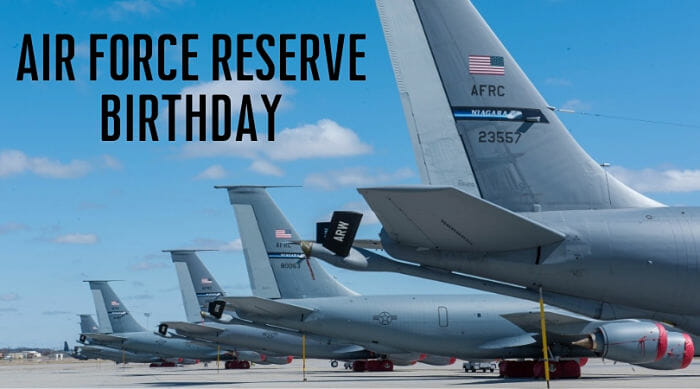
The United States Air Force Reserve celebrates its birthday every year on April 14, but according to the Air Force official site, Air Force Reservists can trace their heritage all the way back to the National Defense Act of 1916.
Reservists in every branch are an important part of the Department of Defense’s strategy for manpower, global reach, and military flexibility. The Air Force Reserve has approximately 450 aircraft, with a great deal of additional aircraft options thanks to the practice of the “associate wing” organization that allows active duty and Reserve components to co-locate flying operations.
The Air Force Reserve is not specifically focused solely on flying missions. Reserve forces include (but are not limited to) medical, civil engineering, intel, space force-type operations, and security.
The Air Force Reserve was created on April 14, 1948 soon after the establishment of the Air Force as a separate branch of service. Before the creation of a separate Air Force, the Army Air Corps flew America’s combat missions, and that organization had its own Reservists. They were transferred wholesale to the Air Force.
1970 brought something called the Total Force Concept, which meant changes in the mission and use of the Air Force Reserve. Concept became policy in 1973; the Air Force Reserve became a multiple mission force flying the same aircraft as active-duty forces.
In the 1980s, there was a push to modernize and expand the Air Force Reserve program. Reservists began flying KC-10 tanker aircraft mid-air refueling missions, plus fighter jet missions in the F-16. The Reserve force would be an important part of both Gulf War missions and that era marked a new chapter in the Reserve force as it became utilized more and more to extend the effectiveness of the total force.
In the aftermath of September 11, Air Force Reserve crews were instrumental in air combat patrol missions in American airspace; those missions included both fighter jet operations and tanker air refueling missions. The present-day Air Force Reserve force includes more than 70,000 Americans serving worldwide.
by larryw | Apr 9, 2021 | American Legion Post 178, POW/MIA, Recognitions
National Former Prisoner of War Recognition Day on April 9th honors the courageous men and women who endured brutal treatment at the hands of their captors. As a result, they also suffered separation from family and displayed incredible endurance and faith during their captivity.
On this day in 1942, the largest number of U.S. Forces were captured by Japanese troops in the Bataan Peninsula in the Philippines. After battling through extreme conditions and prolonged battles, the captured troops were forced to march 65 miles to the prison camp. Without medical attention, food or water thousands died. The mistreatment continued for those who survived the brutal journey. In the compounds, deep in the unfamiliar jungle, the hardships, brutality, and suffering lasted more than two years for those who could survive.
Since the Revolutionary War, over half a million service members have been captured. This number does not reflect those lost or never recovered. However, each POW endures conditions much like the ones described above. These heroes deserve a day of recognition.
In 1984, a movement led by former POWs began seeking a day recognizing for former Prisoners of War on April 9th each year. In 1988, Congress approved legislation setting April 9th to commemorate the date the tragic number of captives were taken prisoner on Bataan. President Ronald Reagan proclaimed National Former Prisoners of War Recognition Day on April 1, 1988, through Presidential Proclamation 5788. He set the observance for April 9, 1988. Since then, through legislation and Presidential Proclamations, the observance carries on. These men and women deserve our respect and profound gratitude.

by larryw | Apr 5, 2021 | Press Release
Texas Boy State delegate interviews were recently completed over a three-week period by an eight-member veteran committee. Larry Wilhelm, the Program Committee Chairman, said, “We had a very strong group of twenty-nine candidates from Frisco ISD and private high schools this year.” The high school principals, counselors, and teachers nominated high school junior students from each of their respective schools.
Because of COVID-19 and the winter storm of February 15, virtual interviews and evaluations were conducted over an extended three-week period. Twenty high school juniors were ultimately selected to attend the 2021 Texas Boys State virtual program from June 27 through July 2, 2021.
The American Legion Boys State, an 85 years-old program, is among the most respected and selective educational programs of government instructions for high school students. It is a participatory program where each delegate becomes part of the process of his local, county, and state government. Using the highly effective experiential learning process, delegates are exposed to the rights and privileges, duties, and responsibilities of a franchised citizen. The training is objective and practical with city, county, and state governments operated by the delegates elected to various offices.
Since June 2014 and including the 2021 selected young men, Post 178 has sponsored 141 Texas Boys State delegates. The highly competitive Texas Boys State program supports mentoring youth, which is one of the Four Pillars of The American Legion.

by larryw | Apr 5, 2021 | American Legion Post 178, Recognitions
The terms Gold Star family, Gold Star Spouses, and Gold Star Wives traditionally refer to the surviving loved ones of military members killed in the line of duty in combat. Gold Star Spouses Day was created to honor these loved ones.
This recognition of the sacrifices made by military spouses is a memorial for the fallen, a day of remembrance for the survivors, and an appreciation for those who are sometimes in danger of being overlooked for their support and service to the country.
The Gold Star is a tradition that began during World War One; service flags were flown by military families during this time, with blue stars for every family member serving in uniform. If one died, the blue star was replaced by a gold star. This allowed members of the community to know the price that the family had paid in the cause of freedom.
The tradition of Gold Star Spouses Day began in the early part of the 20th century as Gold Star Mother’s Day, observed on the last Sunday of September beginning in 1936. An organization known as Gold Star Wives began operating before the end of the Second World War, and the Gold Star lapel button tradition was established in the summer of 1947.
All of this set the stage for Gold Star Spouses Day, which began as Gold Star Wives Day-the first of which occurred in December 2010. Two years later a Senate resolution codified Gold Star Wives Day, observed on April 5 each year. Today the event is known as Gold Star Spouses Day, though many still use “Gold Star Wives Day” interchangeably with Gold Star Spouses Day.
If you know any surviving spouse of any person of the United States military who died while a member of the armed forces of our country, or who died after such service because of an injury or disability incurred during such service, please extend your heartfelt gratitude.